Murli and Kundan @ QPR
Murli and Kundan — My Father, My Son portrait shoot
I have been working on the My Father, My Son photographic project for about four months, slowly building the foundations of something very close to my heart. These are not simply portraits. They are negotiations between presence and absence, between what is spoken and what is carried silently. The project continues to grow as I find new subjects, new stories, and new ways of understanding what it means to be a father, to be a son, and to navigate the space between.
I approached Murli and his son Kundan to see if they would be interested in participating. I have known them for about ten years, and we could be described as camping friends; we are part of a larger group of families in the Ealing area who used to go camping together at least once or twice a year. We have shared conversation and laughter while building tents, flipping burgers, or drinking beer around a firepit in the evening, but we had never connected creatively in this way. Certainly not in any way that would require a deep self-reflection on what it is to have a father-son relationship, and what unique story it holds for each of them.
Murli is a similar age to me ( late fifties) and Kundan is, I think, eighteen now. Their mutual love for QPR became the natural backdrop for the shoot. When I asked if there was anywhere in particular they wanted their portraits taken - somewhere with shared meaning - Murli immediately said Loftus Road. It made sense: he has been a season ticket holder for years and grew up in the area. We exchanged a few WhatsApp messages and the arrangements largely took care of themselves. We met on South Africa Road, outside the main ticket entrance, on a quiet Sunday lunchtime.
I arrived early, as I always do, and took a couple of frames of the location in anticipation of the light, hoping for a little late inspiration as to a useful spot for a backdrop. The area itself borders a 1930s estate on the north side of the road, and the stadium side is not overly interesting - neither architecturally distinctive nor brutalist in any compelling way. It is, I suppose, exactly what you would expect an urban, inner-London football ground to look like. I was a little anxious that it might not be as useful a location as I had imagined, but I put those feelings to one side. I was more concerned about meeting them and figuring out the best approach to the photographs - what I would say, how I would direct them. I am, at heart, quite an awkward person when it comes to communication, which probably explains why I prefer being behind the camera and observing. This kind of work does, however, require directing your subjects and giving them enough feedback that they understand what you are trying to achieve.
By the time Murli and Kundan arrived I had overthought it several times over and was quite nervous. Kundan admitted he found it the most awkward too, and preferred not to remove his jacket; they had arrived wearing the QPR home strip underneath. I said I honestly didn't mind, and that it was important we all felt as comfortable as possible. I went into waffle mode and for the most part can't remember much of what I said, but it must have been fine, because Murli and Kundan seemed to immediately get it. We spent about twenty to twenty-five minutes in a ten-yard stretch outside the stadium, working through a few different set-ups using my digital Nikon D780 with a 50mm lens. I then put it away and pulled out my dad's old Yashica 124G medium format camera, loaded with a roll of Ektachrome. I worked more slowly with it (it takes a little time to focus and line up a shot), and it was at this point that the questions started rattling around: had I taken enough? Were the set-ups different enough from one another? Was this story, in itself, distinct enough to stand among the others?
I took a deep breath when I reached the final frame on the Ektachrome roll and announced we were done. Murli and Kundan offered to drive me home, which I gratefully accepted, and we made small talk about the club - how often they came, the friendship groups they both had and shared. It added more context to their story.
When I looked at the digital images at home, they were better than I had expected. It wasn't so much the location itself, but how Murli and Kundan were within it: at ease, in familiar territory, in a place they felt at home. I sent the Ektachrome roll off to Stuck in Film in Croydon, a film and scanning company I have grown to trust enormously. They are extremely good and reliable, and I would thoroughly recommend them.
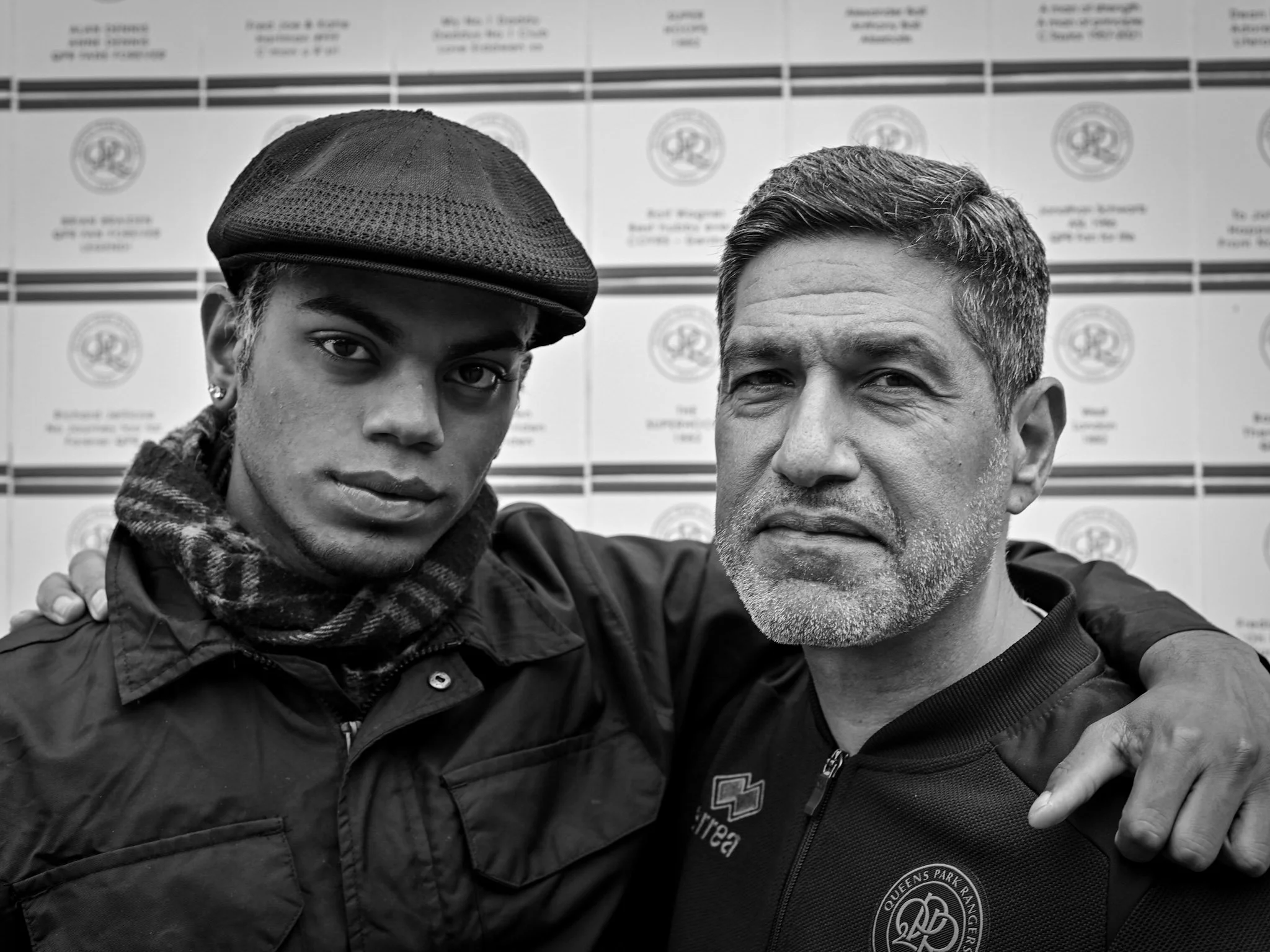
Murli and Kundan - “Belonging”
When I asked each of them to write a sentence about what the other means to them, framed (if they wished), around QPR, what came back said more than either of them perhaps intended.
Murli drafted and redrafted before settling on this: "Our father-son relationship has been strengthened by dealing with the highs and mostly lows of our love for QPR. I'm so happy to see him attend matches with his friends as I did at his age, and know that he is creating lifelong friendships and memories." When I asked him to distil his own childhood experience of the club into a single word, he didn't hesitate: belonging.
Kundan's response arrived differently. It was immediate, fully formed, and funny: "The first letters my Dad taught me to say were ABC - Anyone But Chelsea FC. Love you Dad! "
Together, the two statements describe the same relationship from opposite ends of it. Murli wrote about watching Kundan become who Murli once was. Kundan wrote about being made by his father. For Murli, QPR has functioned since boyhood as what we might call a holding environment; a stable structure through which identity and community could be felt before they could be named. Belonging was absorbed, not chosen. And now, watching his son build his own friendships through the same rituals, the same colours, the same turnstiles, he sees his own formation reflected back across a generation.
Kundan's ABC joke is doing something more subtle than it first appears. It tells us that QPR allegiance wasn't something he arrived at - it was something he was made from, encoded before memory. But the humour is the point too. Theirs is a relationship where love doesn't need to be solemn to be real. The declaration at the end “ love you Dad “ lands harder because of the laughter that precedes it.
The club, in the end, is almost incidental. It is the vessel, not the content. The content is connection, identity, inheritance, and the deep human need to know you are not alone in the world. That is what the photographs are trying to hold.
Max McGonigal © 2026
